
Bird of the Month: Let’s Talk Warblers
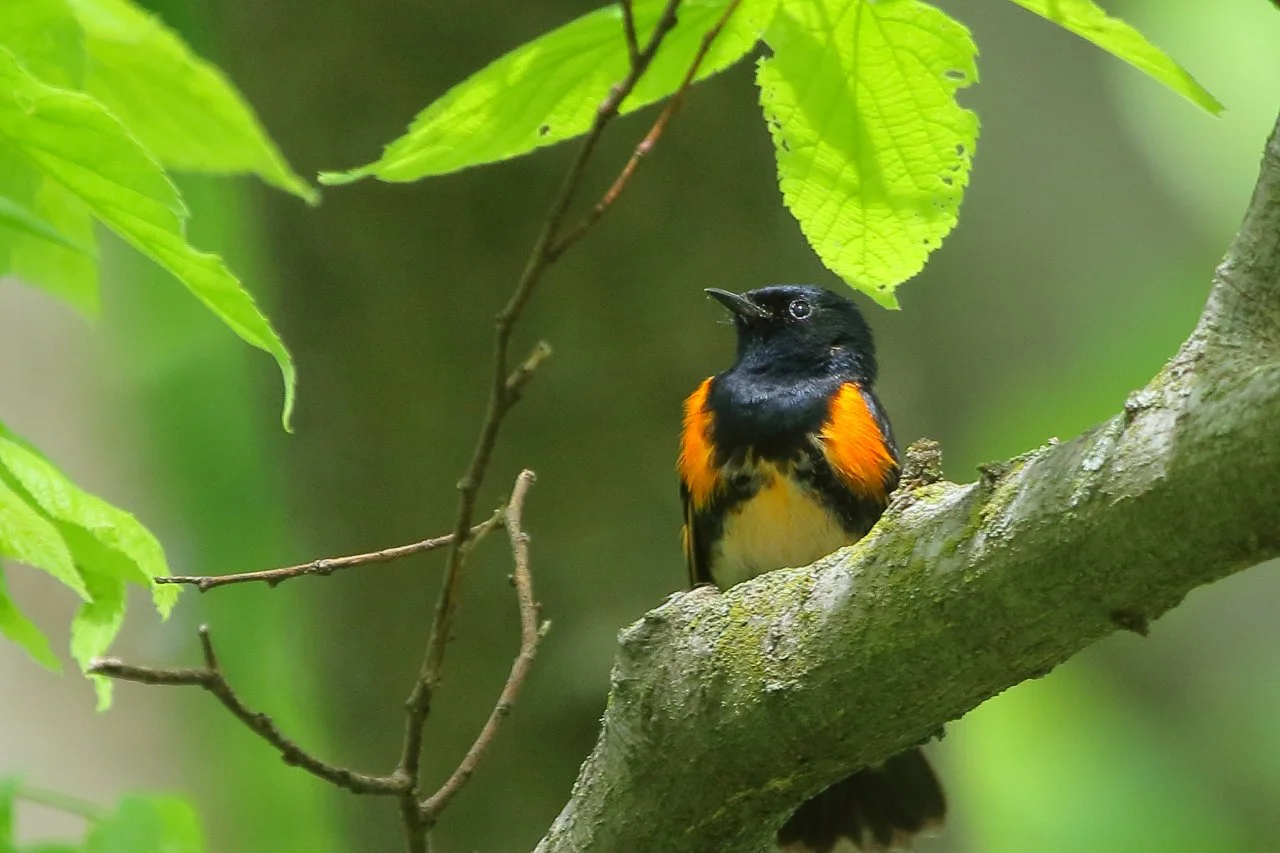
American Redstart. Photo by Jeff Bryant.
Roger Digges, CCAS Vice President
Even though these small, active, colorful birds represent more than 10% of all the birds that spend time in Champaign County, I’ve only included one warbler species in my forty-two Bird of the Month blogs. Why?
My goal in this feature has been to discuss those species which are fairly common and easy for those relatively new to birding to find. While many species of warbler are common in May and September as they migrate through our area, they can be challenging to find and identify. Busily flitting from twig to twig in fully leafed out trees as they glean insects, they may be hard to follow with binoculars. There’s even a name for the condition birders may develop as they search high in a tree for these birds: “warbler neck.” Even so, their striking plumage (especially the males) makes the effort worthwhile.
It was hard to choose just one, but finally I decided on the American Redstart. Like most of our warblers, this species is sexually dimorphic. Adult male redstarts are brilliant, mostly coal black with bold orange patches on their sides, wings, and tails. As with most birds, the plumage of female and immature redstarts is more subdued, showing paler flashes of yellow on their sides, wings and tails with gray heads, an olive back, black wings and tail.
After spending their winters in Central America or the Caribbean, the first migrating redstarts began arriving in our area in late April. Their numbers will peak around late May, then all but a very few will move north into the upper Midwest or lower Canada to mate and raise young. We’ll see redstarts again between late August and early October as they migrate in the opposite direction.
But since they’re in our area now, let’s try to find them. Where should we look? American Redstarts prefer wooded stream corridors and other woodlands near water. I’ve frequently found them at Meadowbrook Park, Crystal Lake Park, and even in my own backyard. While I wouldn’t call where I live a “woodland,” we do have mature trees nearby, as well as an old crabapple tree and an artificial waterfall. But these are just the places I tend to look for warblers.
There are so many other areas you can find redstarts this month: forest preserves such as Lake of the Woods and Homer Lake, the University of Illinois Arboretum and its Allerton Park natural barea, and the Urbana Park District’s Busey Woods. One way to guarantee seeing warblers, including the redstart, is to participate in Champaign County Audubon Society’s Sunday morning bird walks. Led by an outstanding birder and teacher, and accompanied by many others with a range of birding knowledge and experience, this is a great way to find and identify birds. These bird walks are held every Sunday March through May and September through October, 7:30–9:00 am, beginning at the lower end of the Anita Purves Nature Center parking lot. They’re free. Bring binoculars if you have them. Come anyway if you don’t. CCAS will loan you a pair.
The best way to find American redstarts is to look for motion in trees. These birds are very active, even for warblers, and frequently flash their orange (or yellow) patches, presumably to flush prey insects. They will be constantly in motion as bulk up to provide the energy they need to continue their journey north.
How is this bird doing? Even though their numbers have declined by more than 40% over the past half century in the US, a growing population of breeding birds in Canada has kept the number of American Redstarts fairly stable at 42 million birds. How can you help them thrive? Be an advocate for the preservation and restoration of forests and riparian woodlands.
