
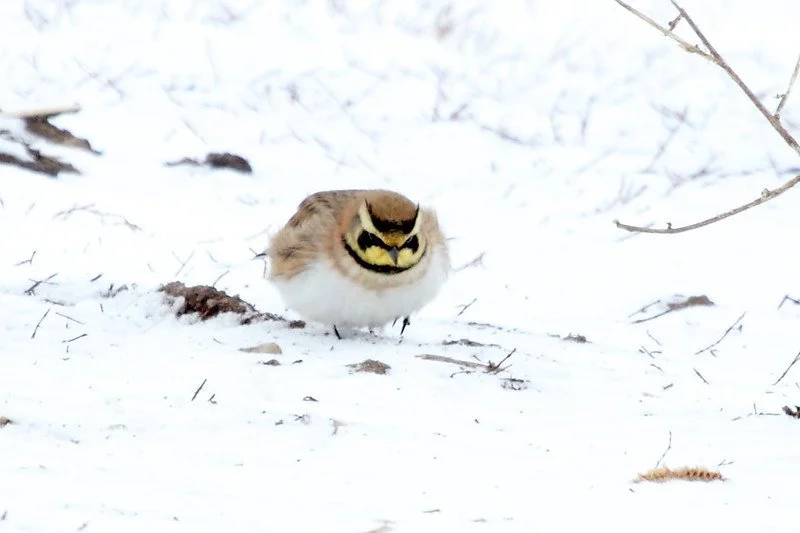
Horned Lark. Photo by Jeff Bryant.
By Roger Digges, CCAS Vice President
I have to confess. I really hesitated before choosing the Horned Lark as Bird of the Month. They won’t fly to your feeders or, for that matter, your yard. You’re not likely to see them in parks or preserves. Unless you work at it, you’re not likely to see them at all. Most of the Horned Larks I’ve found in 40 years of birding have been serendipitous sightings. I wasn’t looking for them, just driving in the country, hoping to spy a Merlin or Hovering Kestrel or a dark-morph Red-tailed Hawk perched on a utility pole.
To be honest, as I looked over my eBird reports, I realized I haven’t seen them as often as I should have. Despite all these caveats, I decided to make this fairly common but overlooked species my Bird of the Month, and challenge myself and you to look for North America’s only lark this winter.
But where do you find Horned Larks? They don’t perch in trees or shrubs or on utility wires. As I said above, they won’t appear at your feeders. Horned Larks like bare ground and areas of very short vegetation, which means harvested or plowed farm fields or large mowed areas such as the edges of forest preserves, sod farms, rural golf courses, or airports. Just make sure you’re a good citizen anddon’t trespass; just look from public roads or other property.
The best way to find these birds is to drive slowly (15-20 mph) along country roads between bare fields. Stop now and then and scan fields. Do not get out of your vehicle as that will spook them. Your vehicle makes an excellent blind because Horned Larks are used to them. Look for small, moving shapes that look like clods of earth suddenly coming to life. If you happen to flush a flock, they will rise in a distinct, jerky, undulating wave pattern, but after circling, often land in the same field or another a short distance down the road.
Don’t just look in the fields. Horned Larks frequently forage for grit and fallen seeds right on gravel shoulders or ditch edges or even on the road itself, especially when snow covers the fields. Remember to check those large mowed areas as well.
So, now that you know where to look, how do you know the birds you see are Horned Larks? The first thing you should pay attention to when you’re trying to identify any bird is what’s known as the “general impression of shape and size” or, more colloquially, the “jizz.” In size, Horned Larks are small and sparrow-sized, but then so are many birds including, of course, sparrows. As for shape, these birds have relatively long bodies, short, thin bills, short necks, and a rounded head (except for the small “horns” visible on some males). That still doesn’t nail down a definite identity.
So, let’s look at markings. Male Horned Larks are sandy colored on top with a black breast band, yellow face, and a black curving mask. They also have a black head stripe that curves around toward the back of the head and may be raised as tiny “horns,” hence their name. Females have similar but more subdued markings and lack the horns.
Horned Larks can be found in our area throughout the year, although not in large numbers. Females begin nesting often while snow is still on the ground. Without help from her mate, she excavates a depression in bare soil, lines it with fine grass or other available vegetation, and lays two to five eggs, and may do so again later in the season. Adult Horned Larks are primarily seed eaters, but they also eat insects and feed their youngsters primarily insects for the protein they need. Horned Lark numbers swell in early winter as birds from as far north as the arctic tundra join our local residents. So, this is a good time to search for these easy-to-overlook birds.
How are Horned Larks doing? Partners in Flight has listed this bird as a common bird in steep decline, losing nearly 2 percent of their numbers every year. Even though the global population, which can be found in most of the northern hemisphere, is 140 million, the decline is somewhat concerning, and researchers don’t fully understand the reason for their decline. We hope that we can help them in some way.
