
Bird of the Month: American Kestrel
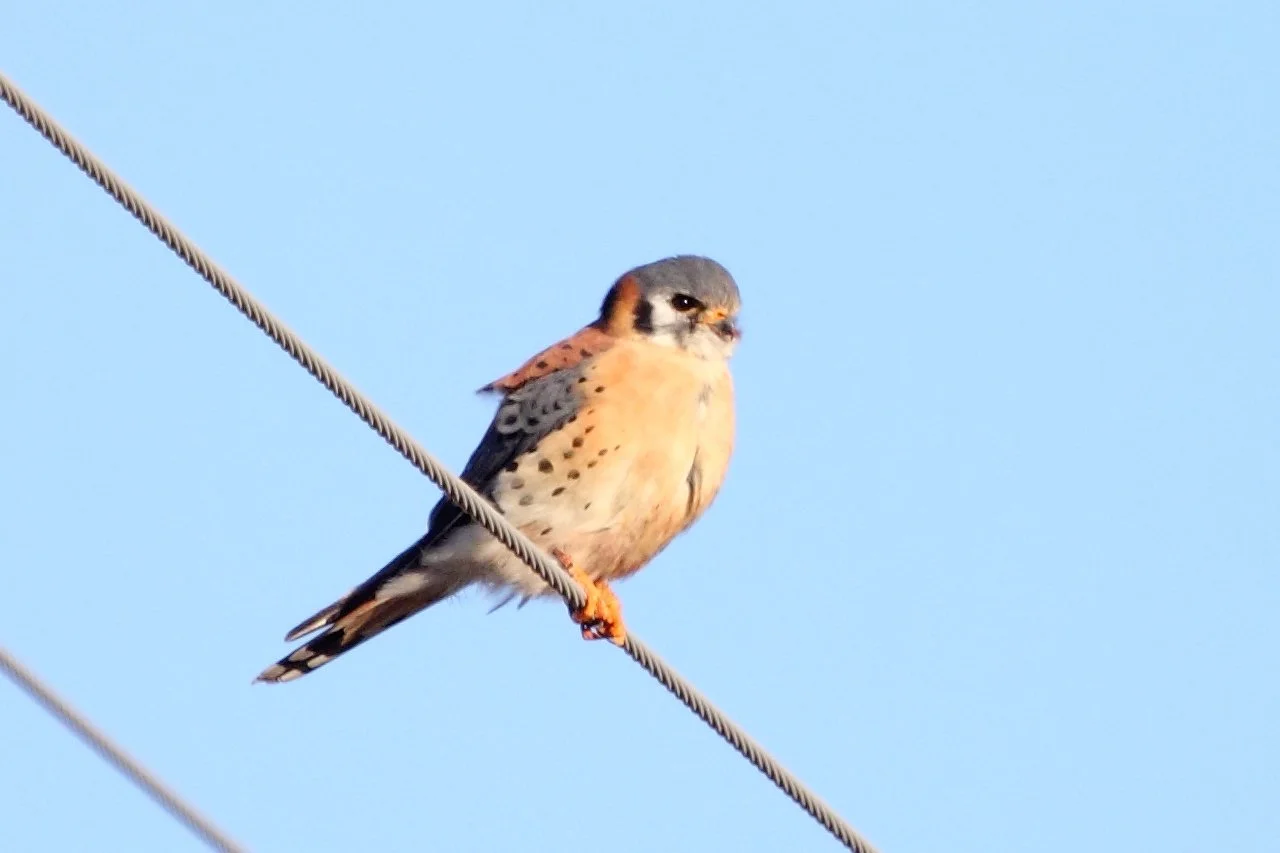
American Kestrel. Photo by Jeff Bryant.
By Roger Digges, CCAS Vice President
Like a lot of beginning birders in the 1980s, I enjoyed paging through my paperback Peterson Field Guide and looking for those little arrows pointing at field marks that maybe could help me identify this bewildering variety of birds I was seeing for the first time. One day I was surprised that a painting, which looked like a colorful songbird, was actually a fierce bird of prey, our smallest raptor, the American Kestrel. Years later when Cathy and I surveyed raptors for the Illinois Ornithological Society, I was delighted to see a number of kestrels, usually perched but sometimes hovering over an open area.
Where can you find kestrels? You might be able to attract them to your feeders if you live in a very open area, preferably with a few trees. However you may not like what they eat: not seed, but possibly one of the smaller birds which use your feeders in winter-a white-throated sparrow, a junco, a chickadee, although kestrels’ usual winter fare consists of small rodents like mice and voles.
What you can do is go for a ride in the country. Follow lightly traveled roads with utility wires along them. Look for a solitary bird perched upright. If it’s safe, pull over far enough away that you don’t spook it. You can use your car as a blind and look at it through the windshield or quietly open a door and step out.
You’ll recognize American Kestrel males by their slate-blue heads and wings, warm brown back and tail, creamy underside, and two striking vertical stripes on its face. A female’s wings are brown, her vertical face stripes not as striking, and she has less blue on her face. Both are elegant birds. In flight kestrels show their light colored undersides and fly rapidly with swept back wings. On a windy day you can identify a kestrel by seeing a bird facing into the wind, flapping its wings to stay in place.
While kestrels are with us year-round, though never in large numbers, there is another less common small falcon that visits Champaign County only in our colder months. Merlins are stockier, darker with streaky undersides, and lack the striking vertical face stripes. You may spot them perched in trees, or more likely, rocketing past with powerful wingbeats in pursuit of a small bird. I confess that most of my sightings of merlins have consisted of recognizing what it was wellafter it was past me.
Some of our winter kestrels are migrants that have flown from as far north as central Canada, while others have been here all year. Still other of “our” kestrels have chosen to avoid winter by flying south.
Whether Champaign County birds spent the winter with us or not, males will start looking for suitable nesting cavities in April. If you live in or near a large open area, you might help him by putting up a nest box (you can access plans for one at https://nestwatch.org/learn/all-about-birdhouses/birds/american-kestrel/).
While American kestrels are fierce and deadly predators, they are also preyed on by Cooper’s Hawks and Sharp-shinned Hawks, Red-tailed Hawks, even American Crows. Their biggest threat, however, comes from human beings. As urban sprawl takes more land out of production and as people take down more dead trees, kestrels have less habitat to hunt in and fewer nest sites to raise young in.
The removal of hedgerows and other land cover to increase agricultural field yields also reduces prey habitat and nest sites. The greatest threat to kestrels’ well-being may be the use of pesticides. These destroy insects, spiders, and other kestrel prey as well as reduce the number of eggs a kestrel female may lay or how many may hatch successfully.
Those who live in the right habitat can help by considering nest boxes. All of us can advocate protecting habitat and a reduction of harmful chemicals.
