
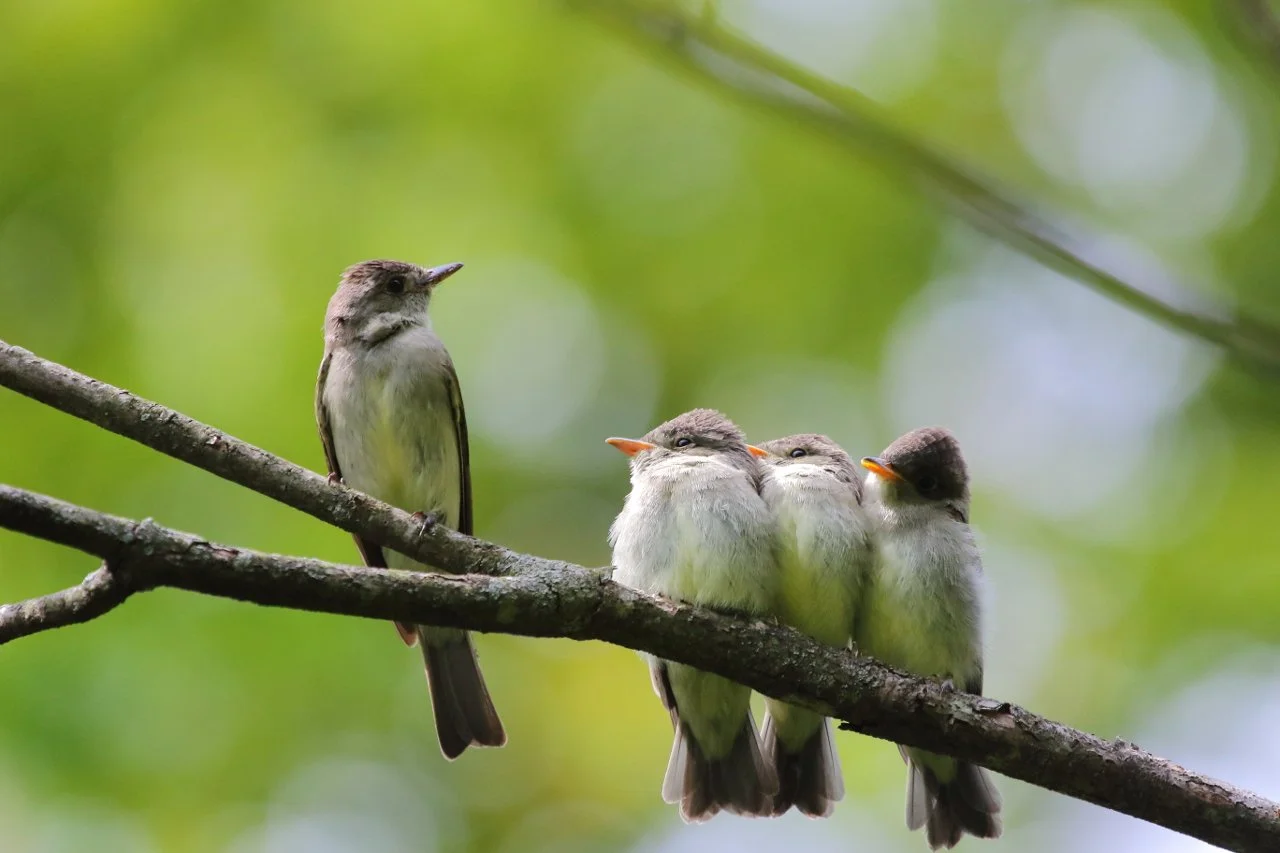
Eastern Wood-pewee. Photo by Jeff Bryant.
Roger Digges, CCAS Vice President
Last month we looked at the American Redstart, which like most warblers is colorful, highly active, and often difficult to locate as it flits about in often deep foliage. This month let’s explore the life of a bird that is not colorful, perches quietly until it spots a flying insect, flies out to catch it, and then returns to the same perch.
The Eastern Wood-pewee is 1 of 10 species of flycatchers that regularly visit Champaign County during the warmer months. After spending their winters in South America, these small, rather drab birds arrived in Champaign County in early May. The female wood-pewee got to work soon after she arrived by starting her nest in the branch of a tree 15 to 70 feet off the ground. She wove a small (3 inches in diameter) cup out of grass, lined it with hair, moss, and plant fibers and then covered it with lichens so that it would blend into the rough bark of the tree. At the same time the male was staking out his territory with song.
He will feed his mate for the 2 weeks that she is incubating her 2 to 4 eggs. After the eggs hatch, both adults will fly out from their perch, catch insects, and feed them to their young until they’re old enough to catch their own.
Where do you find Eastern Wood-pewees? You can hear them in Meadowbrook, Crystal Lake Park, Busey Woods, and any place where there are woods—public parks, forest preserves, wooded residential areas.
How do you find them? Listen. Eastern Wood-pewee males sing loud and often throughout the day, especially at dawn and dusk. Their song is easy to remember because the bird sings its name repeatedly: pee-a-wee.
Turn toward the location of the sound and look for a bird flying out from and returning to a perch usually on a dead branch at mid-level. On average an Eastern Wood-pewee will “sally” forth about once a minute to catch insects to feed its young.
What do they look like? Eastern Wood-pewees are small, olive-gray birds with long dark wings and tails, off-white throat and belly, and little or no eye-ring. They have a bicolor bill, the underside yellow-orange. If you watch for a bit, a male may sing for you and verify its identity.
These birds will stay with us all summer, their numbers first swelling in late August as more northerly nesters begin to pass through our area, then gradually declining until the last birds head toward South America in mid-October.
How are Eastern Wood-pewees faring? Like most birds, its numbers have declined between 1966 and 2019 according to the North American Breeding Bird Survey—the Eastern Wood-pewee by 44%. But with an estimated population of 6.5 million, the International Union for the Conservation of Nature (IUCN) Red List still rates them as a species of low concern.
