
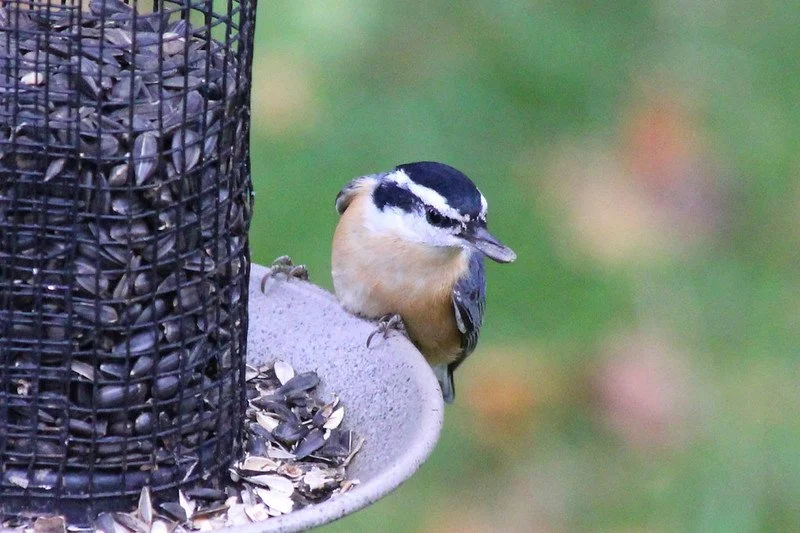
Red-breasted Nuthatch. Photo: Jeff Bryant.
By Roger Digges, CCAS Vice President
As Cathy and I carried our luggage toward the lodge we’d be staying in at Yellowstone National Park six weeks ago, we heard a variety of bird sounds, most of them unfamiliar. But I immediately recognized one call that I have heard many times in my own backyard, just not in late summer and early fall. Cornell Lab’s All About Birds calls that vocalization “an excitable yank-yank” that sounds like “tiny tin horns being honked in the treetops.” I waited for it to reveal itself and it soon did, a small bird with a longish beak and a short tail, an orange breast, and a dramatically patterned black-and-white face.
While Red-breasted Nuthatches reside in Yellowstone year-round, they only visit our area during the colder months with the peak of their fall migration in October. How do you find them? Red-breasted Nuthatches like trees, conifers, as well as aspens and poplars in the mountainous west, and deciduous trees such as oaks, hickory, maple, and birch, as well as conifers in the northeast and Midwest. To find these delightful birds, you could visit local forest preserves, wooded parks, or any place that trees cluster together. When you walk through these areas, listen for that unique call, then look for a bird climbing up or down tree trunks, or upside down or right-side up along tree branches, probing for possible food.
Like most songbirds, Red-breasted Nuthatches are insectivores, at least during summer and late spring, dining on beetles, caterpillars, spiders, and ants as well as feeding them to their young. As chillier temperatures make insects scarcer, these birds switch their diets to include seeds.
Those of you who have bird feeders and live in a fairly wooded neighborhood can attract Red-breasted Nuthatches to your yard. Over the years I’ve found that they are fond of peanuts, sunflower seeds (I use black oil sunflower seeds), and suet. I have observed them at both my tube feeders and platform feeders, and occasionally my suet feeder. While they may linger at a feeder somewhat longer than their White-breasted Nuthatch cousins, Red-breasted Nuthatches often will leave to wedge the seed or peanut into a crevice in the bark of a tree, and hammer it into smaller bite-sized pieces.
Despite their small size, Red-breasted Nuthatches don’t give way to larger birds at the feeder. I have found that only Carolina Wrens are bolder when I go outside to refill feeders. The Red-breasted Nuthatch will always be one of the very last species to fly away.
How is this attractive and lively bird doing? Unlike most songbirds, the population of Red-breasted Nuthatches is increasing, according to the North America Breeding Bird survey. Partners in Flight estimates that there are 20 million Red-breasted Nuthatches. Even so, there are things we can do to stabilize or increase their numbers. One way we can help is to plant trees, especially conifers, or support the planting of trees either locally or in the northwestern mountains where they nest and raise their young. We also can provide tree cavities. Red-breasted Nuthatches often use these during especially cold periods. If you have a dead or dying tree on your property that isn’t a danger to leave upright, consider leaving the dead tree and girdling the dying one. Red-breasted Nuthatches are capable of making their own holes in softwoods or will use those made by woodpeckers. Good viewing!
Just a reminder that the Champaign County Audubon Society continues to hold Sunday morning bird walks every Sunday morning in October, 7:30 to 9:00 a.m., meeting at the southwest corner of the Anita Purves Nature Center parking lot.
