
Bird of the Month: Rose-breasted Grosbeak.
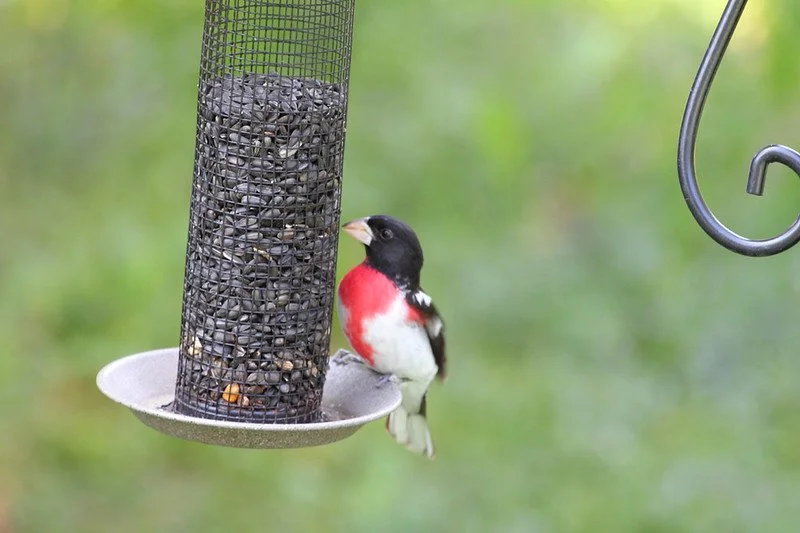
Rose-breasted Grosbeak. Photo by Jeff Bryant.
By Roger Digges, CCAS Vice President
As our calendars roll into September, this is a perfect time to get outside and observe birds. Temperatures drop an average of 10 degrees over the course of the month, 14 degrees cooler than summer’s high heat. But more importantly, the number and variety of species you can hear and see increase greatly. The warblers that delighted us as they stopped over on their way north are now coming south again. However, they don’t look the same. They’ve molted the bright breeding plumage and grown more subdued non-breeding plumage. Birding apps can help you identify what have been called “fall’s confusing warblers.” But nothing helps you find such birds or identify them like birding in a group. So I would advise you to participate in our Sunday morning bird walks, 7:30-9:00 a.m., starting at the north end of the Anita Purves Nature Center parking lot. It’s a great way to find birds you may miss on your own, and there are often a number of experienced birders around you.
It’s far easier to identify September’s bird of the month. Although many Rose- breasted Grosbeaks have been with us since late April, busy raising youngsters, many more will be appearing in September as those birds that nested as far north as Canada begin their migratory journey to Central and northwestern South America, and the Caribbean.
Where can you find them? Rose-breasted Grosbeaks like woodlands—forest preserves, wooded city parks, and residential areas with mature trees. It helps if such woods are close to open areas, streams, or wetlands.
How can you find them? As with most songbirds, listen. Rose-breasted Grosbeaks have a cheerful, whistled song with ups and downs like a robin’s song. Some authors have described it as sounding like a robin that has taken singing lessons. If you need some help identifying the song, download the Merlin app, if you haven’t already. It’s free and accurate about 85 to 90 percent of the time. Use it to find the singer and get your binoculars on it, so that you’re sure that’s what it is.
What does it look like? Males are unmistakable: black on top and white underneath with a brilliant red triangle on its breast. When I see a brilliant flash of black and white fly by in the woods or toward my feeders, it’s usually a male grosbeak. As is the case with most songbirds, female and immature Rose-breasted Grosbeaks wear more sensible camouflage plumage, a streaked breast with a yellowish wash, and streaked brown above. You can identify them easily by their large beaks and bright white eyeliner. As their name suggests (en francais), all grosbeaks have large beaks that are perfect for cracking seeds or the hard shells of large insects, much like their more familiar cousins, our Northern Cardinal.
The wonderful thing about Rose-breasted Grosbeaks is that they are one of the most striking birds you can attract to your bird feeders. They love black oil sunflower seeds. At times I’ve had as many as half a dozen at once, usually in May, but occasionally in September and October as well. They may linger for as long as 10 minutes, offering a photo op if you have a camera to capture their image. After a summer of seeing mostly year-round birds, it’s exciting to welcome such colorful visitors, if only for a short time.
While Rose-breasted Grosbeaks are a relatively common forest bird with an estimated population of 4.7 million (according to Partners in Flight), their numbers are slowly decreasing. Since grosbeaks nest in saplings, it’s possible, as young woodlands are maturing in the eastern U.S., that such transitions can account for some of the reduction in their population. Unfortunately, there is another possible cause. In Central and South America and the Caribbean, Rose- breasted Grosbeaks are trapped and sold as cage birds. They’re beautiful and their songs are sweet. How much this affects their numbers is unknown. Bird conservation is almost always a complex matter.
