
Bird of the Month: Tree Swallow
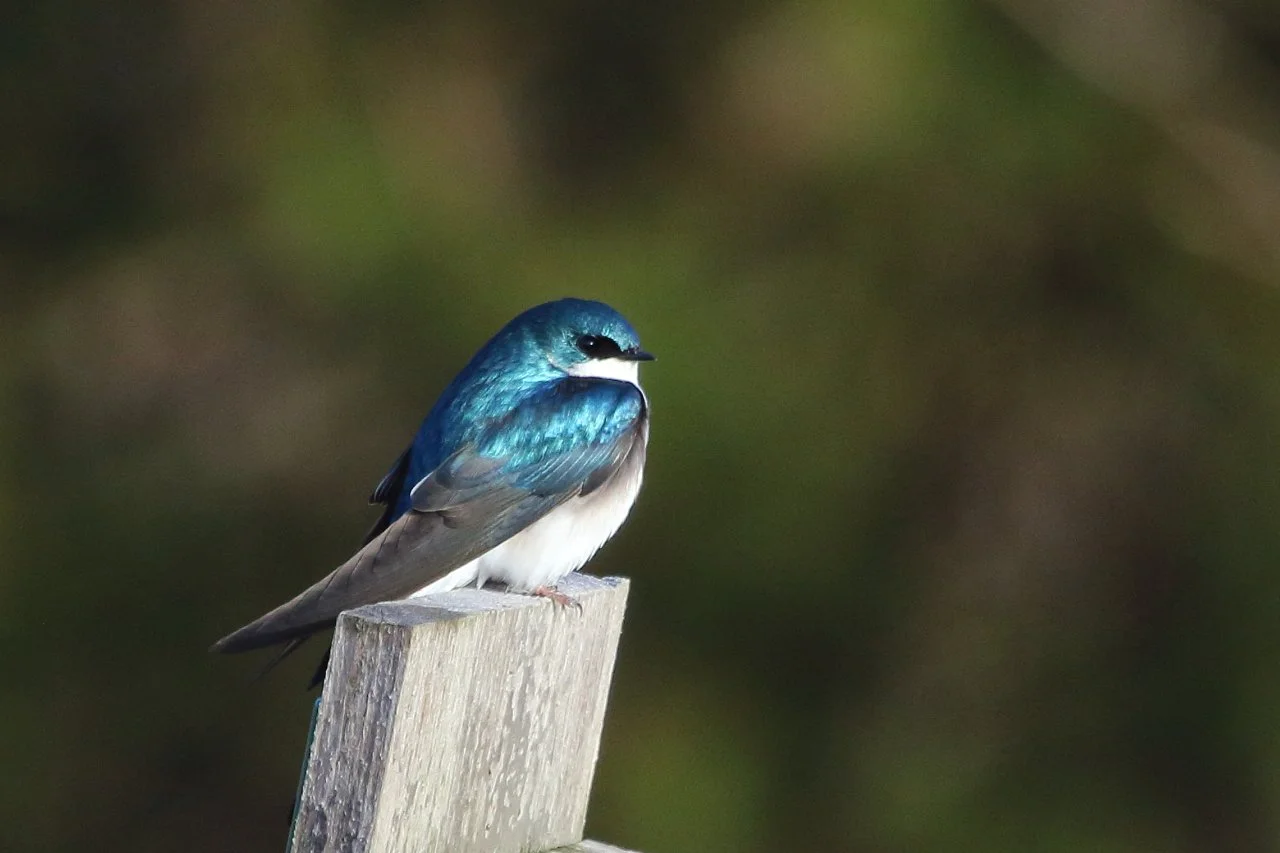
Tree Swallow. Photo by Jeff Bryant.
By Roger Digges, CCAS Vice President
Cathy and I have walked in the early morning at Meadowbrook Park for two decades. Every year there are two bird species whose spring arrival we especially look forward to. As I write, one of them, Red-winged Blackbirds, have already shown up, their “o-ka-lee” reaching our ears well before we first saw them. But it’s the sight of that second species, Tree Swallows, which swoop over us with elegance, grace, and incredible aerial skill, that is truly a feast for our eyes.
Only one or two scouts show up at first checking out nest boxes for possible egg-laying sites. But it isn’t very long before there are at least twice as many pairs as there are boxes. For a few days they will engage in aeronautical battles that never seem to do any harm, but determine who will own a home for their future offspring or who will look elsewhere. Soon the Tree Swallows have sorted it out, one pair to each box.
Tree Swallows are striking birds, their metallic blue upper parts contrast with their snow white undersides. Of all the swallows, I think they are the most remarkable fliers, wheeling high over prairies, fields, ponds, lakes, or swamps, twisting and turning suddenly to catch a tasty insect for their breakfast or to bring to their always hungry and insistent young. More than once I’ve watched a successful parent rocket past its nest box, then turn 180 degrees to enter their box at full speed. Perhaps they do this to throw off any potential predator, or maybe they’re just having a good time.
If you live near a grassland, lake, or marsh, you might be able to attract these birds to your own yard if you put up a nest box. You can follow this link for instructions on how to build and where to place it: https://nestwatch.org/learn/all-about-birdhouses/birds/tree-swallow/. Otherwise, you can find Tree Swallows almost anywhere near grasslands, open water and available nest cavities or boxes. Here in Champaign County you might see Tree Swallows at most of the Champaign County Forest preserves, particularly Homer Lake, Lake of the Woods, River Bend, and Middle Fork, anywhere there is a generous supply of flying insects. When they’re not in flight, they perch in trees, shrubs, or on utility wires.
Observers in Champaign County usually spot the first Tree Swallow scouts around the beginning of March and will report increasing numbers a month before any other of the six swallows which nest here. There are two reasons for this early arrival. Tree Swallows overwinter further north than the others, in the southeastern United States rather than Mexico or the Caribbean. Not only do they have fewer miles to travel here, they can also start much earlier. Unlike the Purple Martin, Bank Swallow, Barn Swallow, Northern Rough-winged Swallow, and Cliff Swallow, Tree Swallows can supplement their usual diet of insects with berries when cold or inclement weather grounds aerial insects.
Male Tree Swallows are the first to arrive, finding and defending a suitable nest cavity. The female builds the nest itself, mostly out of grass. She and her mate collect feathers with which to line the nest, and she forms a cup by pressing her body in the feathers before laying 4 to 7 eggs. In a few weeks, both parents will be busy catching insects to feed those hungry mouths.
By July, we tend to see fewer Tree Swallows as parents and fledged young leave nesting areas, such as Meadowbrook Park, to join larger flocks that congregate around larger lakes, some in Champaign County, some further away. Before October, the last of our Tree Swallows have headed south.
How are Tree Swallows doing? Like most birds around the world, despite a population of 20 million, their numbers have dwindled, in their case by one-third in the past half century. How can we help them? Advocate for the protection of woodlands, the preservation of standing dead trees, and a reduced use of pesticides. And if you’re in the right habitat, put up nest boxes.
