
Bird of the Month: Tufted Titmouse.
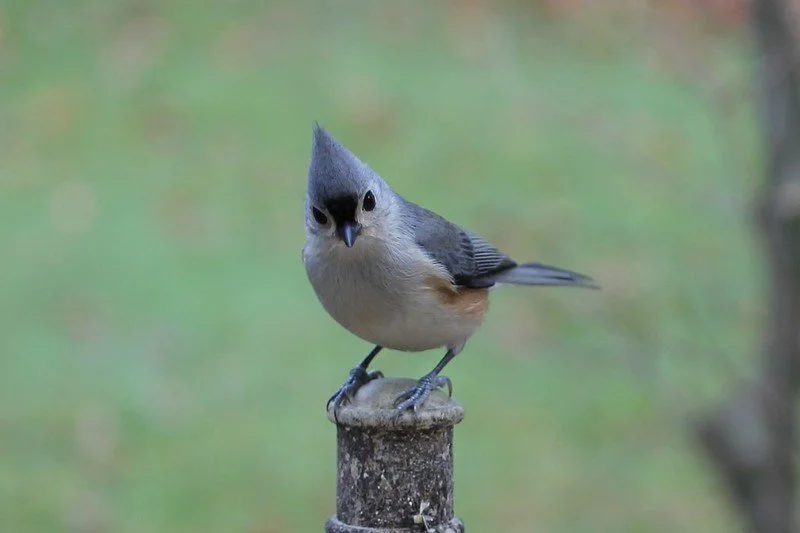
Tufted Titmouse. Photo by Jeff Bryant.
By Roger Digges, CCAS Vice President
Tufted Titmice have been living in my neighborhood all year, and very possibly yours as well, although I tend to see them much more often in the cooler weather of late fall, winter, and early spring. But sometimes even in summer, as I work on the endless task of weeding around the native plants in my yard, my friend Merlin and I hear their song. I invite Merlin (the app) to join me because sometimes, if I haven’t heard them for a while, I have a little trouble distinguishing their songs from the loud vocalizations of our local Carolina wrens.
Looking like small, gray cardinals complete with a crest and stubby beak, Tufted Titmice stay in the southeastern third of the U.S. year-round. Once the weather warms enough in the spring, titmice search for a hole to build their nest in. They use natural holes or those made by woodpeckers, but will readily use one that you have provided. Nest boxes are available online, or you can build one yourself from plans you can obtain from Cornell Lab’s Nest Watch.
The female titmouse will build the cup-shaped nest out of damp leaves, moss, grasses, and strips of bark, lining it with hair, fur, wool, or cotton, sometimes removing the hair directly from live mammals. Her mate will provide her with food as she works and later as she incubates the three to nine eggs she will lay. Both birds will feed the young nestlings.
Titmice eat mostly insects during the summer, which is why we see so few of them at feeders, switching over to seeds in fall and winter. They are particularly fond of sunflower seeds, which allow us to attract them to our yards. I offer them black oil sunflower seeds in hanging platform feeders. I find that, like the chickadees and nuthatches they sometimes hang out with in winter, they don’t linger at a feeder. They’ll fly to a perch where they will hold the seed in their foot and hammer it with their beak to free the kernel from the hull. Often in the fall and winter, after removing the shell, they will stash the seed bark crevices not far from the feeder, much as chickadees and White-breasted Nuthatches do.
But what if you have no yard or no titmice in your neighborhood? No problem. Besides yards, titmice like to spend their time in woodlands, which means you can find them in any of our forest preserves and a number of our municipal parks any time of year. As we do with most birds, listen for their characteristic call or song. The Merlin app can be helpful in identifying them. Then follow the sound to look for the birds. Look for titmice flitting about high in the forest canopy. While you might find them quietly perching on a twig, titmice often hang upside down or sideways as they explore crevices, underneath branches, and in leaf clusters.
How are Tufted Titmice doing? Like their occasional winter buddies, Black- capped Chickadees and White-breasted Nuthatches, their numbers in North America are increasing as their range has moved northward. Although ornithologists have no definite evidence as to why this is happening, possible reasons for their range expansion include a warming climate, farmlands reverting to forests (mainly in the east), and the growing popularity of backyard bird feeders. So, keep those feeders full over the winter, and continue to advocate for leaving dead trees standing if they pose no danger so that titmice remain 12 million strong.
