
Bird of the Month: Wood Duck
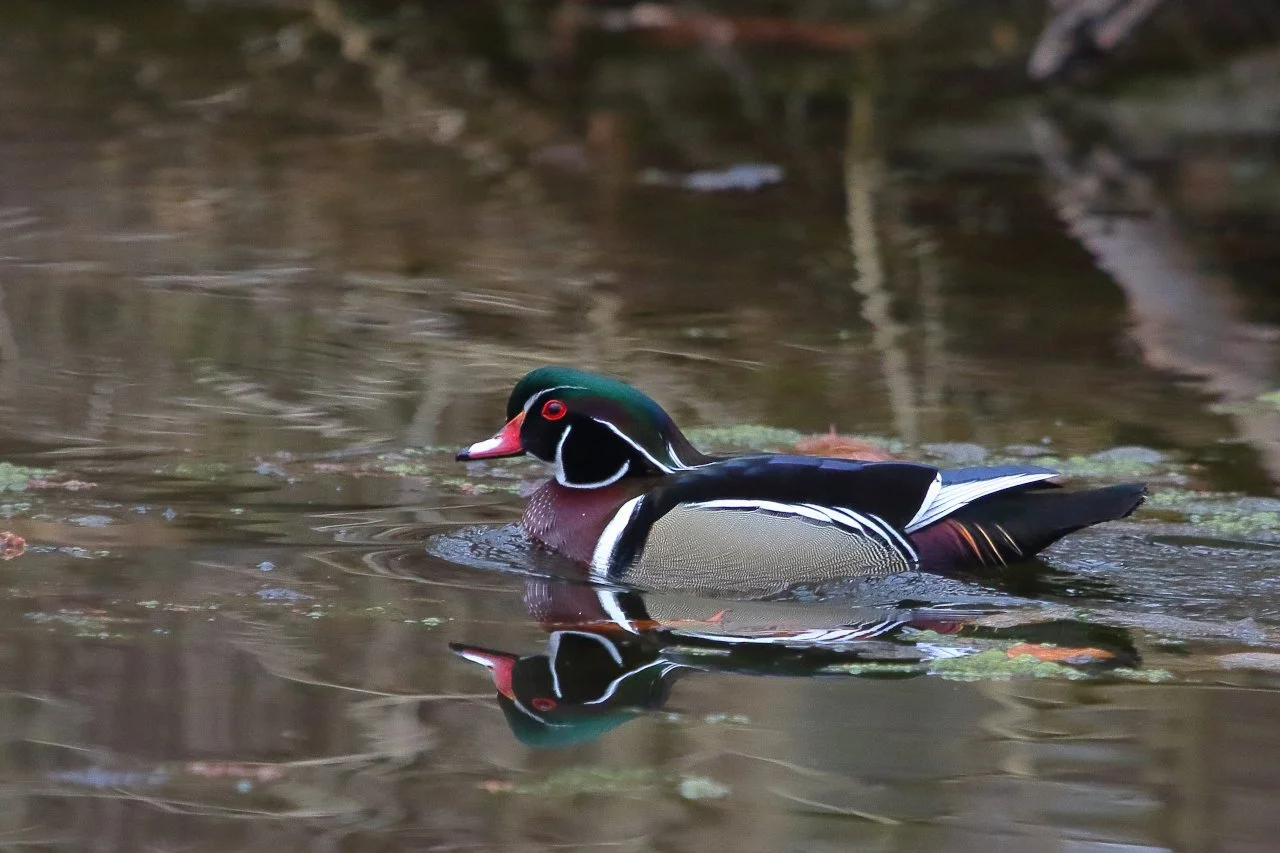
Wood Duck. Photo by Jeff Bryant.
By Roger Digges, CCAS Vice President
The male Wood Duck is one of the most beautiful waterfowl that spends time in our area, with a dark green face dramatically patterned with white, chestnut breast, rakish crest, and other eye-catching plumage. The female member of the species wears more subtle feathers, as female birds generally do to protect themselves from predators while nesting or caring for young. But she still has a unique white teardrop-shaped area around her eyes that distinguish her. And it’s her high-pitched whooo-eee you hear as she flies away when startled. Both birds can be recognized in silhouette by their distinctive oblong heads, and in flight by their bright bellies and contrasting dark underwings and breast.
Although wood ducks have been reported in Champaign County in winter, only mild winters offer them the open water that allows them to stay. Overall, this has not been that kind of winter. “Woodies,” which migrate to our south, usually begin coming back to Champaign County in March, you should be able to find them this month.
Where do you look? Wood Ducks favor bottomland forests, wooded swamps and ponds, and slow-moving wooded streams of all sizes. Do you sense a pattern here? Wood Ducks prefer water surrounded by trees. They feed in still or slow-moving water with nearby brush and a few fallen trees.
Wood Duck hens lay their eggs in tree cavities, choosing mature trees 1-2 feet in diameter with an appropriate cavity 2-60 feet high (the higher the better). Most cavities are places where a branch has broken off and the tree’s heartwood (near the center of the trunk) has rotted. Here a female will lay 6-16 eggs which will incubate for 4-5 week.
On the day they hatch, the downy young, coaxed by their mother, will use their claws and beaks to climb to the lip of the nesting cavity. And jump, sometimes 50 feet. Because hatchlings are light and have soft bones, they bounce unharmed off the forest floor. And once they all have landed, mom leads them to the nearest water, which may be as far as a mile away. Then they begin eating plants and invertebrates, just like her.
Like all our birds who nest in tree cavities, Wood Ducks face a severe housing shortage. There aren’t enough mature trees with the right sized nest holes, and even though many Wood Duck lovers have put up nest boxes, there still aren’t enough places for Wood Duck hens to lay eggs. As a result, many females resort to what is known as “egg-dumping,” laying their eggs in the nests of other hens. Some nests have been found which contained as many as 30 eggs.
Where can you find Wood Ducks in our area? I’ve seen them in small streams like McCullough Creek in Meadowbrook Park, in the Saline Branch at Crystal Lake Park, in a number of swampy areas in Busey Woods, in quieter stretches of the Sangamon River, and in the Salt Fork of the Vermilion River. Other birders have spotted woodies in places such as Kaufman Lake or Homer Lake Forest Preserve, anywhere in the county where there are tree-lined still or slow-moving bodies of water.
How is this gorgeous bird faring? Despite the shortage of nest cavities and the fact that more woodies are shot by hunters annually than any other duck except mallards, researchers estimate that their population may be growing, and there are currently more than a million Wood Ducks. It’s hard to arrive at precise figures because tree-loving Wood Ducks can’t be easily counted from the air the way most waterfowl can.
How can you help Wood Ducks? Advocate for the preservation and the quality of wooded swamps, ponds, lakes, and rivers. If you would like to put up a Wood Duck nesting box, visit https://nestwatch.org/learn/all-about-birdhouses/birds/wood-duck/ for plans and placement of a wood duck nest box.
Happy hunting (binoculars or cameras only!).
