
Bird of the Month: American Goldfinch
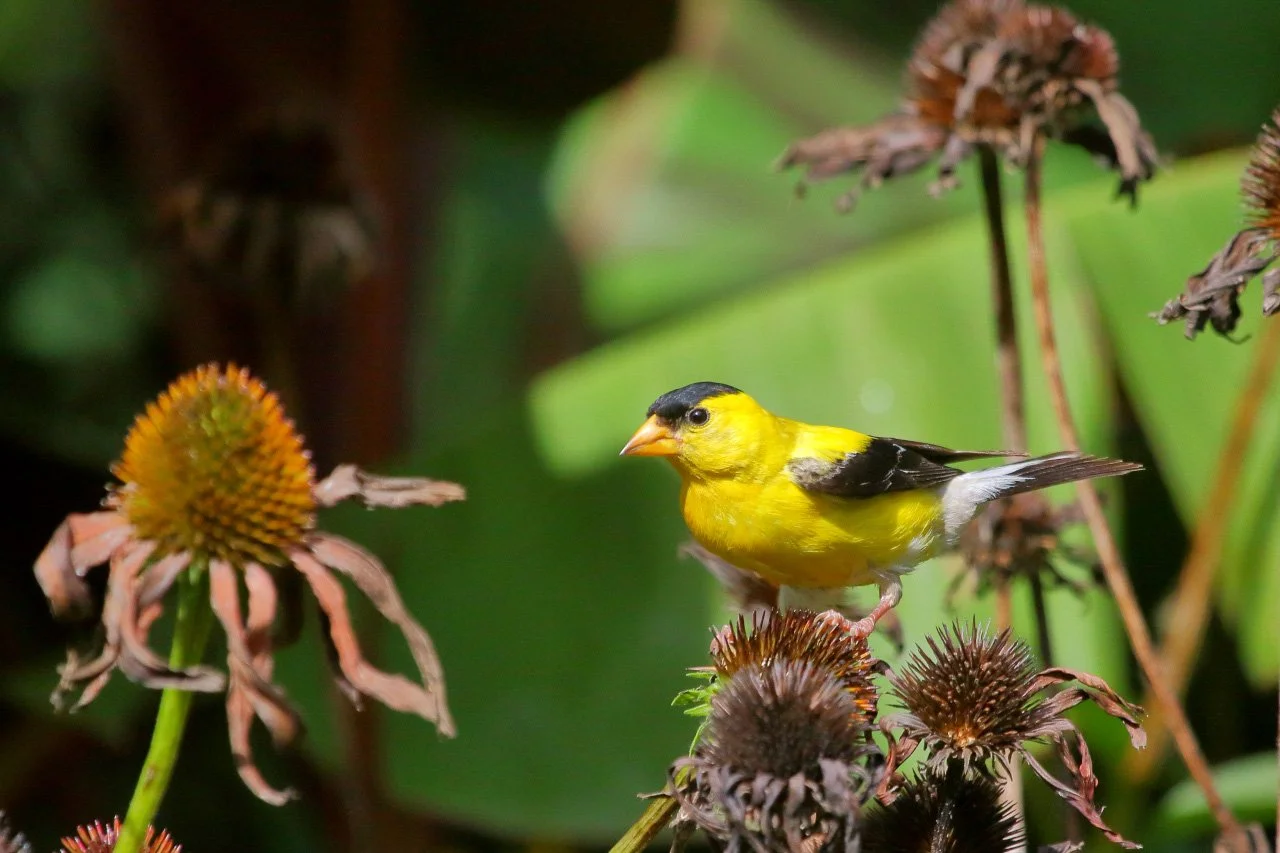
American Goldfinch. Photo by Jeff Bryant.
By Roger Digges, CCAS Vice President
Like most members of its biological class Aves, American Goldfinches wear two differently colored plumages depending on the time of year. Both sexes are characterized by dull gray-brown feathers outside of breeding season.
Once the time to attract a mate rolls around, the male’s plumage changes to a bright yellow with black wings and forehead. You can’t miss them. Females, like the females of most bird species, go for a more camouflaged look. You can see a hint of yellow on their face, back, and flank, and you’ll notice darker wings than they have in winter with light colored wing bars.
One of my favorite sights of spring is seeing that first vividly yellow male show up at one of my bird feeders, sometimes with a more muted yellowish female joining him.
You can attract these delightful birds to your yard by growing plants like native thistles, native milkweed, purple coneflower, black-eyed susan, native sunflower, and native goldenrod. You can also provide bird feeders with seeds; sunflower and nyjer seeds are their favorites.
You can find this common bird anywhere in the lower 48, except in dense forests. Goldfinches love open areas, woodlands, weedy fields, flood plains, parks, and residential neighborhoods. You may hear them first, as they make their flight call, which has been described as po-ta-to-chip. Their undulating flight is quite recognizable as they call while they’re flying.
Goldfinches eat seeds almost exclusively, which makes them easy to attract. Their diet also provides them with a means of combating brown-headed cowbirds, a nest parasite. Cowbird females deposit their eggs in the nests of a number of species, to the detriment of those birds’ own young. But brown-headed cowbird chicks cannot survive more than three days on seeds alone, not long enough to outcompete the host parents’ own smaller young.
I selected the goldfinch as our August bird of the month because one has a better chance of seeing them building their nests or feeding their young in late July or early August.
Goldfinches nest this late in the season because the plants they depend on, like thistles and milkweed, are in full flower in late summer. The fibrous downy materials from plants like thistles and milkweed supply material for female goldfinches to build their nests.
The abundance of seeds allows goldfinch parents to more easily find food for their chicks. For birders, long after the Red-winged Blackbird, Tree Swallow, Kingbird, Catbird, and many other summer birds have raised their young, we still have the bright yellow male (and somewhat muted yellowish female) goldfinches flying back and forth bringing food to their demanding offspring.
Already mated pairs of goldfinches have been surveying your neighborhood, favorite park, nearest shrubby area, anywhere open near trees, for the ideal nesting spot. They’ll find a small tree or shrub and she will begin building the nest high in the woody plant usually at the intersection of two or three branches.
She will tightly weave a 3-inch cup, 2 to 5 inches high, out of rootlets and plant fibers, tied to the intersecting branches for support with spider webs, and lined with down so tightly packed that it can hold water. This will take her 6 days, after which she’ll lay 2 to 7 bluish-white eggs, which will take 12 to 14 days to hatch. She will incubate the eggs while her mate brings her food. Over the next 2 weeks, they will share the responsibility of feeding their nestlings.
How are goldfinches doing? Like most North American birds, their numbers have declined. But there are still an estimated 44 million of them. How can you help? Plant native milkweed and thistles; advocate for the protection of open but “messy” habitat.
