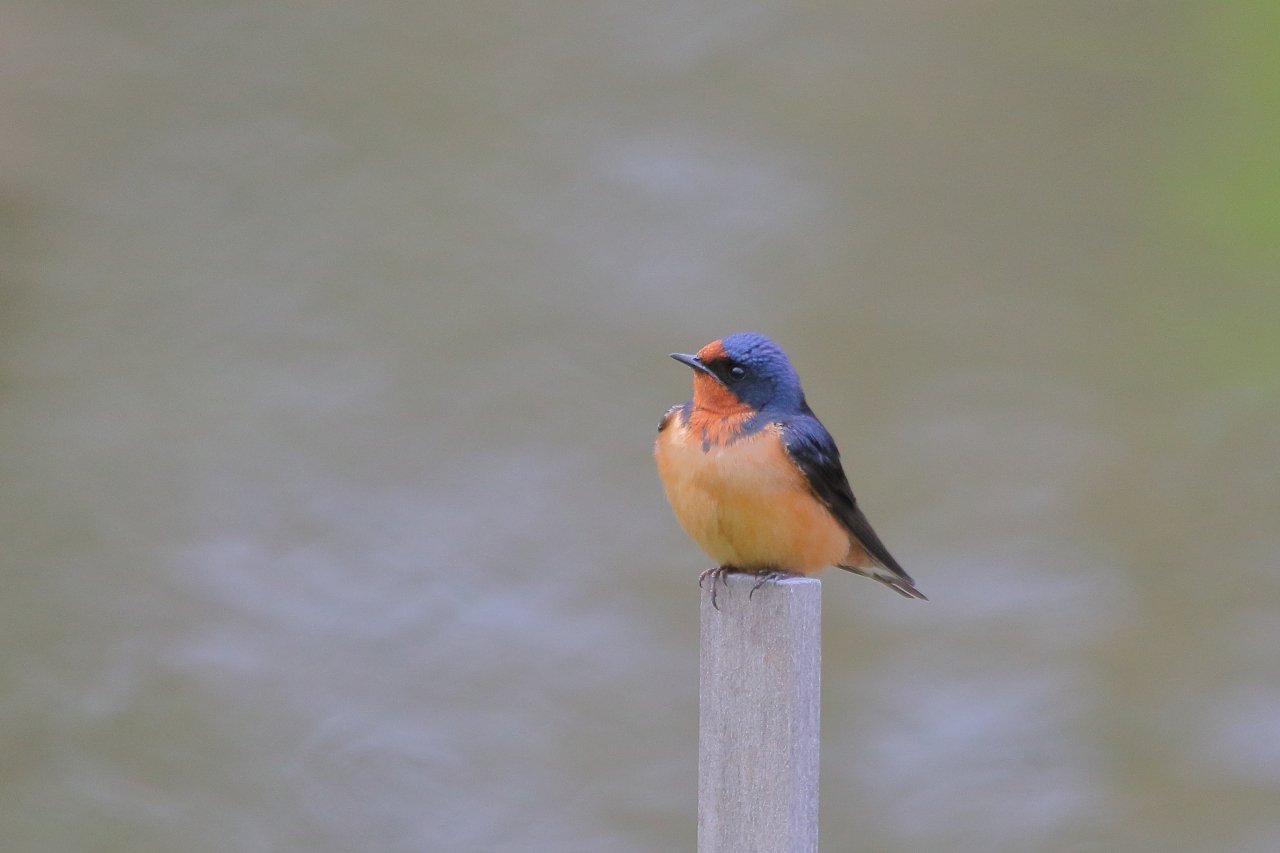
Barn Swallow. Photo by Jeff Bryant.
By Roger Digges, CCAS Vice President
This month’s bird is common throughout the United States, easy to find, and quite recognizable. According to Cornell’s All About Birds, the Barn Swallow is “the most abundant and widely distributed swallow species in the world.” Breeding in most of North America, all of Europe, most of Asia, and northwestern most Africa, Barn Swallows overwinter in Central and South America, the southern half of Africa, south Asia, Oceania, and northernmost Australia.
Barn Swallows first began arriving in our area from their overwintering areas in late March and will be with us all summer, some birds staying well into the fall. Fortunately, this gives us plenty of time in the weeks ahead to look for them.
So, what do we look for? For me, there are three key indicators.
In my experience barn swallows tend to fly lower than other swallows, cruising just inches above grass tops or lakes. This is not always the case, but when I see a swallow in very-low-level flight over a meadow or other grassland, it’s usually a Barn Swallow.
Barn Swallows are also the only swallow in our area that have an orangish underside. While Barn Swallows are similar to Tree Swallows, with both birds having a deep blue back, the Tree Swallow has a white underside. Barn Swallows also have a reddish-orange throat similar to Cliff Swallows, but Cliff Swallows have a tan forehead and nape.
The chief diagnostic detail, however, is that Barn Swallows have the deepest (and longest) forked tail by far of all the swallows that visit our area. A Hopi legend explains this feature. A Barn Swallow stole fire from the gods to bring warmth and light to human beings. An angry deity shot flaming arrows at the bird, singeing off its middle tail feathers, leaving it forever forked. Ornithologists probably tell a different story.
Once we know what to look for, where should we look?
Barn swallows have two basic requirements. They need open areas, such as meadows, parks, fields, roadway and ditch edges, marshes, ponds, or small lakes so as to find the flying insects that they depend on. Barn Swallows also require dry places in which to build their mud nests.
Before Europeans came to North America, Barn Swallows nested in caves. After these newcomers began building artificial structures like barns, outbuildings, eaves, and bridges, these resourceful birds gradually shifted to using them for nest sites.
You may have spotted a Barn Swallow nest in such a place, a cup made of mud gathered by the swallows, 2 inches deep and 3 inches wide. I’ve seen them under the roof of the Overlook at Meadowbrook Park, under its bridges, in old barns whose farmers I visited, in cabins where I’ve spent the night, and in many other places.
Among the many other local places where you can find Barn Swallows are Crystal Lake Park, Kaufman Lake, Homer Lake Forest Preserve, Middle Fork Forest Preserve, Lake of the Woods Forest Preserve — anywhere there is open water, grassy fields, and available structures for building nests.
If you’re driving in the country, you may see them flying over grassy fields or along drainage ditches. This past spring, I saw several fly in front of me along a ditch at Country Arbors, so keep your eyes open.
If you live in the right habitat, you can attract Barn Swallows to your own property. If you own an outbuilding whose window or door you don’t mind leaving ajar, that may draw a nesting pair.
You can also build or buy a nesting shelf, which Barn Swallows use as a platform from which to build their nests. You can even buy an artificial nest cup ready-made.
How are Barn Swallows doing? Like most insectivorous birds, they are experiencing a gradual decline. The good news is that there are still 190 million of them around the world, and people like having them around and want to keep them.
