
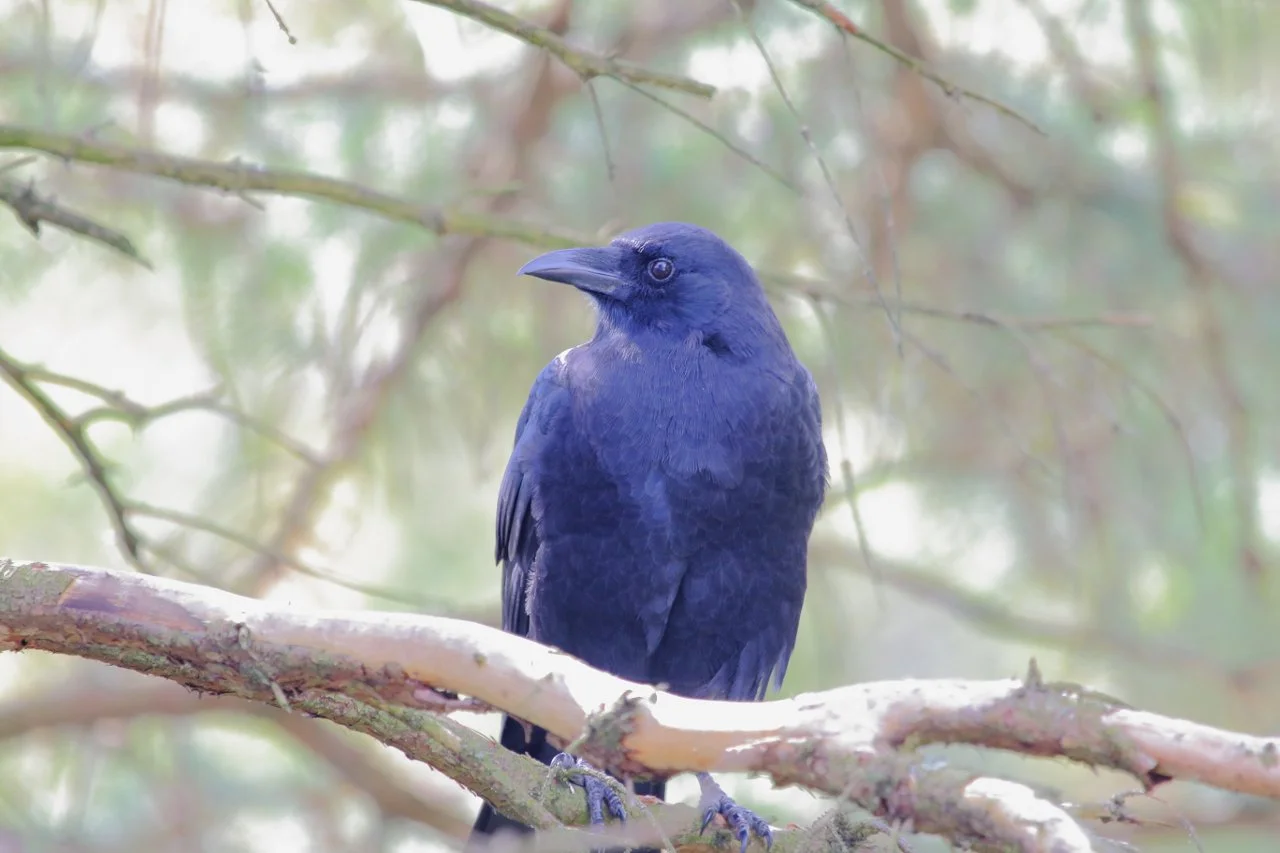
American Crow, Photo by Jeff Bryant.
By Roger Digges, CCAS Vice-President
This month’s featured bird is so common and so recognizable you might wonder if I’ve finally run out of interesting Champaign County avian residents and migrants to describe. No, there are still some 280+ species I haven’t covered yet. The truth is I’ve wanted to write about the American Crow for a long time, partly because I’ve encountered them everywhere I’ve gone in North America, from British Columbia to Key West, from San Francisco to Newfoundland, and, of course, all over Champaign County. I’m sure you have too.
We see them flapping through our skies, gleaning local fields, picking through garbage, cleaning up roadkill, perching on fenceposts, even flying over our yards. So finally writing about a bird almost everyone will see this month, probably even from your car. I don’t need to describe them. You already know they’re big black birds that caw. Nor do I need to tell you where to look for them. Almost anywhere.
But I would like to share what makes them uncommon. Crows are smart. In an article How Smart Are Crows? on the website ThoughtCo.com, Dr. Anne Marie Helmenstine maintains they are as smart as a 7-year-old human child. She describes a study in which volunteers wearing masks captured, tagged, and released crows. The crows later recognized and attacked anyone wearing those particular masks but did not attack any other persons. Even crows not involved in the study attacked people wearing those masks.
Somehow the studied crows had communicated with others who the bad guys were. Helmenstine writes “[While] crow communication is poorly understood, the intensity, rhythm, and duration of caws seem to form the basis of a possible language.”
In my own yard, I’ve heard crow vocalizations change when I’ve gone outside to put another suet cake in my hanging feeder. Two crows would land under the feeder. One would fly up, hover, pull suet out of its cage, then drop down so that it and its partner could share the feast. Since their appetites are voracious, eventually I had to buy a less accessible feeder.
In another study, crows learned how to retrieve a floating treat in a tube too deep to reach with their beaks. They dropped objects into the water, objects that didn’t float and weren’t too large for the tube, until the water level rose high enough that they could enjoy their snack. Smart.
These brilliant birds live year-round in most of the United States, including Champaign County. It helps that they can eat an amazing variety of food, from grain, seeds, nuts, and fruits to garbage. They also prey on small rodents and aquatic animals as well as the eggs and nestlings of many bird species. Crows don’t generally use bird feeders but may visit your backyard if you have a mix of trees, open space, food, and water. They like peanuts or pet food scattered on the ground. (Warning: So do rats, mice, voles, and squirrels so don’t leave it out overnight.)
Crows are guides that can point you to the nearest large avian predator by engaging in “mobbing.” If you hear a loud cacophony of crows, it’s likely they’ve located an owl or hawk, which they see as a potential threat. Great Horned Owls are particularly dangerous to crows because they can come out of the dark and snatch even an adult crow off of its perch. I remember seeing an owl fly by while I was participating in a Christmas Bird Count, but didn’t know what it was or where it went until the angry crows led me to it.
How are these remarkable, adaptable birds doing? Their numbers have been stable over the past 50 years, despite predatory owls and human hunters. But they have an invisible enemy that can bring them down: Orthoflavivirus nilense, commonly called West Nile Virus. Virtually all crows in an area infected by this microscopic invader die within a week. While there is no cure, we can help crows by eliminating standing water, planting mosquito repelling plants (lavender, mint, and marigolds), and attracting mosquito-eating birds and bats.
